
The Summer Olympic Games are once again upon us, and I am inevitably transported back to 1996 when Atlanta served as the world’s host.
I began my post-college journalism career at The Macon Telegraph as a general assignment features writer. It was the best job in journalism I would ever have, and I appreciated it too little at the time. Instead, I focused on transitioning to covering news and moving up the ranks to become an editor. I was ambitious but shortsighted. Only now do I look back and appreciate the great stories I had an opportunity to tell as a features writer.
When I first learned The Telegraph would be offering a limited number of reporters an opportunity to receive official media credentials to cover the 1996 Summer Olympics in Atlanta, I knew I had to be one of the reporters selected. I didn’t cover sports, but I had in the past, and as a features writer, I could justify helping to round-out the paper’s coverage of the Olympics by getting human interest and local impact stories. In my mind, I would do a great job, dazzle my editors, and use the Olympics to pivot from writing features to covering news. My career, which was four years-old at that point, would take off.
What I didn’t account for when I hatched this scheme was how much fun I would have covering the Olympics. I viewed it as a step toward a larger goal, but it was very much a goal unto itself. The centerpiece of my experience was covering the modern pentathlon. It was such a profoundly memorable day that it has become one of my favorite “go-to” stories I love to tell over and over.
Because The Telegraph was owned by the Knight Ridder newspaper chain, the half-dozen or so credentialed reporters and editors from The Telegraph were assigned to work in the Knight Ridder section of the main press center, or “MPC” as it was called throughout the Summer Games. Located in downtown Atlanta in the building that then housed the Inforum and now the American Cancer Society’s national headquarters, the MPC would be my home throughout the Olympics. My editors came from papers all over the country. They were experienced news and sports editors who had covered previous Olympic games. I checked in with them every morning, received my assignment and deadline for the day, and made contact with my editor back in Macon to make sure I was delivering them the stories they needed to fill the paper. I was able to cover a mix of sports and lifestyle stories giving me a unique perspective on the spectacle that was the Atlanta summer games.
On the sports side, my assignments included men’s basketball, women’s field hockey, and baseball. On the features side, I covered the abundance of vendors that popped up to sell licensed merchandise, wrote about what international guests thought of Georgia, followed the mascot “Izzy” for a day, and covered the closing ceremonies. My stories were not consequential to Knight Ridder’s coverage, and The Telegraph was not in danger of shutting down if I had not been there. The lack of stakes just added to the fun. I took my assignments seriously, didn’t begrudge my low-profile, and tried my best to write interesting and engaging stories.
The best of all my assignments came on day 11 of the Summer Olympiad, July 30, my 26th birthday. I was assigned to cover the modern pentathlon.
Prior to the moment the editor handed me the press kit for the sport, I don’t think I had ever heard of the modern pentathlon. I could easily deduce it involved five events, but I had no idea what those were. I poured over the media packet and learned the original version of the event concluded the games in ancient Greece and consisted of running, jumping, spear-throwing, discus and wrestling.
The ancient version of pentathlon held a position of unique importance with the winner ranked as “victor ludorum” or “winner of the games” in Latin. The so-called modern version was re-introduced into the games in Stockholm, Sweden, in 1912 by Charles Pierre de Frédy, Baron de Coubertin, a French educator and historian. He was the founder of the International Olympic Committee and its second president. Known as the father of the modern Olympic Games, de Coubertin’s version of the pentathlon included the five skills needed to be a military scout at the time: Pistol shooting, fencing, swimming, horse riding and running. He believed the event would test “a man’s moral qualities as much as his physical resources and skills, producing thereby a complete athlete.”
By 1996, interest in the sport was waning. The team competition was eliminated in 1996, and the individual competition was in danger of being removed from the Olympics. Its “modern” label was a bit of a misnomer.
The sports involved were not widely known or appreciated in the United States, so the Modern Pentathlon International Committee had to come up with strategies to combat its inherent challenges. The modern pentathlon had previously been on five separate days of the Olympics giving the athletes ample time to recover between events. However, it was not ideally suited for fan interest, requiring spectators to show up at five different venues on five different days.
Much more popular in Europe and the former Soviet republics than in America, organizers of the Atlanta games arrived at a solution to ignite ticket sales and drum up interest. All five events were to be held on a single day. The Modern Pentathlon International Committee hired actor Dolph Lundgren to be its celebrity spokesperson. Best known for his role of Russian boxer Ivan Drago in “Rocky IV”, Lundgren spoke at a press conference, posed for photo shoots and took individual interviews on the history and importance of the modern pentathlon. In addition to a one-on-one media availability with the celebrity spokesperson, reporters were also promised the royal treatment of catered meals, media work spaces for filing throughout the day, and transportation among the far-flung venues. Despite the inducements, Knight Ridder chose to send the features writer from Macon to cover the 1996 competition.
The day started at 7 a.m. at Hall H of the Georgia World Congress Center where pistol shooting and fencing would take place. I had never covered anything resembling either sport, and it was difficult to get my bearings. The shooting involved a line of men on a range, pointing air pistols at targets about 30 feet away. They fired a specified number of shots at targets within a time limit and scoring was electronic. It didn’t take long, and it was impossible to know at a glance who had done well. They handed me a results sheet showing Philipp Waeffler of Switzerland, whoever that was, had won. Before I knew it, the few reporters covering modern pentathlon were whisked into the cavernous room next door for fencing.
Fencing was a spectacle. Two competitors facing off in a duel is as primal as it gets, but fill a giant convention hall with 32 men dueling in a round-robin tournament and the action becomes almost impossible to follow. Each pair dueled on a mat to confine the combat, and the competitors wore a white suit and face mask electrically tethered to a computer to record touches. They all looked identical, so following individual competitors was next to impossible. They dueled, bowed, unplugged and went to their next assigned mat and dueled, bowed, unplugged and moved again.
The flourishes of the epees and rapid shuffling of feet made it impossible to focus. It was a 32-ring circus of constant movement lasting three hours. It was much longer than the pistol shooting because each of the competitors dueled each other in 31, one-minute bouts. When the event ended abruptly, I had no idea who was winning or who anyone was. I cannot imagine how a play-by-play announcer or color commentator could conduct a broadcast of the chaos I had just witnessed. Again, the staff handed me a sheet showing Kazakhstan’s Aleksandr Parygin and Ukraine’s Heorliy Chymerys tying at 21 wins a piece. Parygin was in first place overall.
We wrapped up at the Georgia World Congress Center by late morning and bussed over to the aquatic venue at Georgia Tech for the swimming portion. Divided into eight lanes, the 300-meter race was held in four heats, and the winner was determined by overall time. I finally started to understand the action better, and the drama picked up.
Since I was a two-year-old splashing in the tub re-enacting Mark Spitz’s 1972 gold medal spree, I have enjoyed Olympic swimming competitions. Attendance was aided by the overflow of spectators who stayed to watch after synchronized swimming, and the swim was American Michael Gostigian’s best event. I’m sure they had no idea what they were watching, but it was the Olympics and it was a race. In the end, the Republic of Georgia’s Vakhtang Yagorashvilli finished first, and the overall leader after three events was Italy’s Cesare Toraldo.
We were then bussed more than 30 miles from Georgia Tech to the Olympic equestrian venue at the Horse Park in Conyers. I took a little nap on the ride out, but the notorious Atlanta traffic caused the competitor bus to be delayed by a half hour.
It was a little after 5 p.m. before the pentathletes and their mounts started jumping, and like shooting and fencing, I had no experience covering equestrian sports. The nuances of the version included in modern pentathlon made it even more compelling. A computer draw randomly assigned competitors a mount with which they had 20 minutes to get familiar enough to ride through a course of 12 obstacles.
Only three of the pentathletes completed the course with no faults, and for the first time I appreciated how difficult a sport horse jumping was. The pentathletes had a lot on the line for the fourth of five events. The rules of modern pentathlon required competitors to complete each event. If for any reason a competitor could not finish that competition, they were disqualified. I felt great sympathy for the Australian, Alexander Johnson, who had the unlucky draw of an unruly horse named “Kirby.” He had numerous faults on the course and finished the run hanging off the horse sideways, trying desperately to avoid disqualification. He failed and was disqualified while Hungary’s Janos Martinek finished first. Toraldo remained the overall leader.
The modern pentathlon concluded at 7 p.m. with the run. Also held at Horse Park, the pentathletes ran a 4k cross country course in three laps with the starting and finish line inside the stadium. The start of the race was staggered by the standings, so whoever finished first in the run would be the overall winner and gold medalist.
Because he was in first, Toraldo received a 15-second head start over Parygin who started ahead of the Russian Eduard Zenovka, who was in third but was the event’s strongest runner. About 10,000 people were on hand to witness the finale, and the anticipation grew for a big finish to this obscure sport as Toraldo left the track and sped out of sight.
By the end of the first lap, Parygin had caught up to Toraldo and trailed him by a few steps. When the second lap ended, Parygin entered the stadium first, but now Zenovka was a few steps behind him. As they entered the stadium on the final lap, Zenovka led with Parygin close behind. I was on the edge of my seat. I had spent the past 12 hours learning these sports, getting to know these athletes through their performances, and appreciating their skills and athleticism. It was all coming down to this final test of speed, endurance and will.
Zenovka put on a furious kick with about 50 meters to go, extending his lead over Parygin. Realizing the gold was beyond his grasp, Parygin raised his arms in celebration over a silver medal finish. But Zenovka began to fade, and Parygin realized he could catch him. He put on a burst of speed, and as he passed, Zenovka tripped and fell, just a few feet from the finish line. Parygin had won gold.
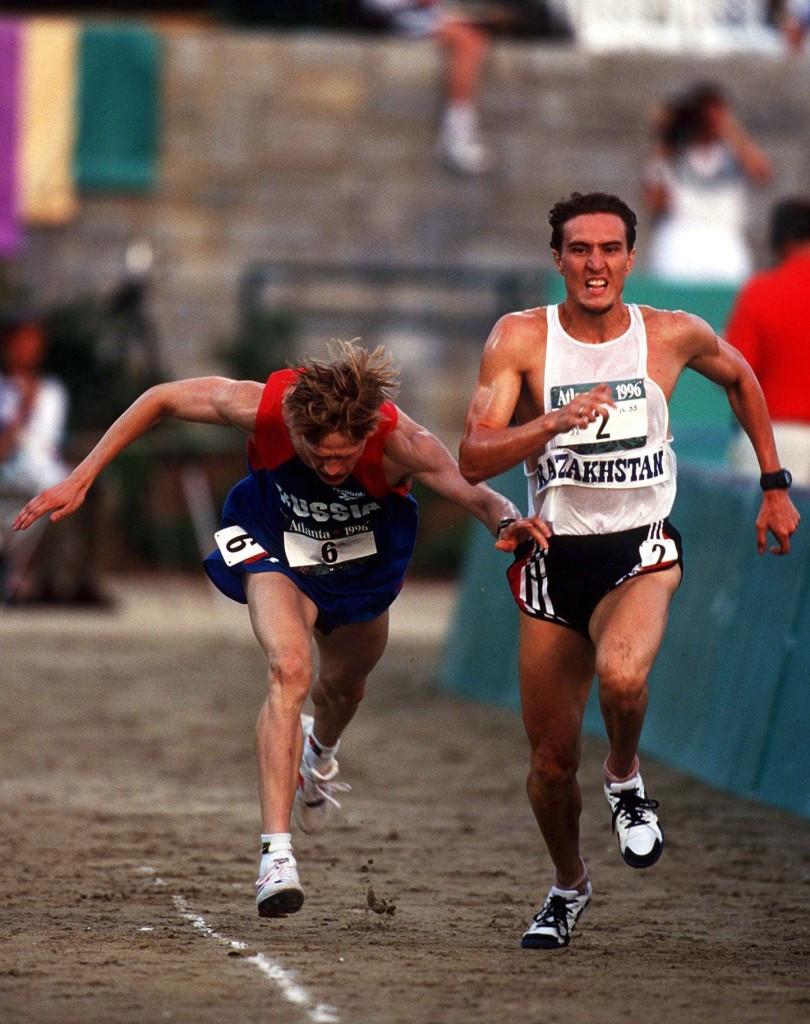
You can watch a two minute clip of the dramatic finish on YouTube.
In the post event press conference, Zenovka explained the moment he lost the gold in broken English: “I lost power.” Surprised, elated, and unable to fully comprehend, the moment, Parygin showed as much sheer joy and sincere enthusiasm as I have ever witnessed in an athlete.
By this point it was nearing 9 p.m., and the buses were leaving for the MPC. I found a workstation in the Knight Ridder newsroom and typed my story from the version I had handwritten in my reporter’s pad. It had been a great day of work and a wonderful birthday. The 1996 modern pentathlon became the defining moment of the Summer Games for me, encapsulating the Olympic motto of “Citius, Altius, Fortius” or “Faster, Higher, Stronger.”
And like in 1996, the modern pentathlon is in danger of being cut from the Summer Games, so it continues to evolve. In 2008, the air pistol was replaced with a laser target shooting and was combined with the run. So like the Winter Games’ biathlon in which competitors cross-country ski and have to stop and target shoot, the pentathletes run a 3k course, stopping to shoot their laser guns. What is more modern than that?
There are also a number of other changes to the format for Paris. A compressed competition timetable will be followed. All five disciplines will be contested within two hours (90 minutes of total competition with 30 minutes of total break time) for the semifinals and finals, instead of three hours of competition spread across more than five and a half hours.
The other big change from the Tokyo Games is that the competition will now take place over three days instead of two, with a semifinal elimination round being added between the fencing ranking round and final. Only the top nine athletes per semifinal (for a total of 18) will advance to their respective finals. There are a total of 72 athletes competing this year.
The order of events has also changed for Paris. The event will be held at the Palace of Versailles, and the favorite is the gold medalist at the Tokyo Games, Joe Choong of Great Britain. The riding competition will now be first, followed by the fencing bonus round, the swimming discipline, and finally the laser run. This change occurred due to refusals by horses randomly assigned affecting the standings. Paris will be the last Olympics where the equestrian discipline will be competed. It will be replaced by an obstacle discipline moving forward.
After a debacle with the horse jumping portion at the Tokyo games in which athletes were disqualified because the mounts they were assigned refused to jump, the next Summer Games will not have horses jumping at all, instead the competitors will have some kind of obstacle course.
I, for one, will miss the horse jumping, but I applaud the sport for trying to stay as “modern” as possible. If you want to watch, the modern pentathlon is scheduled for August 8-11.
 New South Essays