
It’s the first week of the year, and if you’re like me, it’s important to know now what the weather and moon phase will be on March 26.
(That’s warm with scattered showers and first quarter on the way to waxing gibbous, by the way.)
How did I know that with 88% certainty?
The Old Farmer’s Almanac, of course.
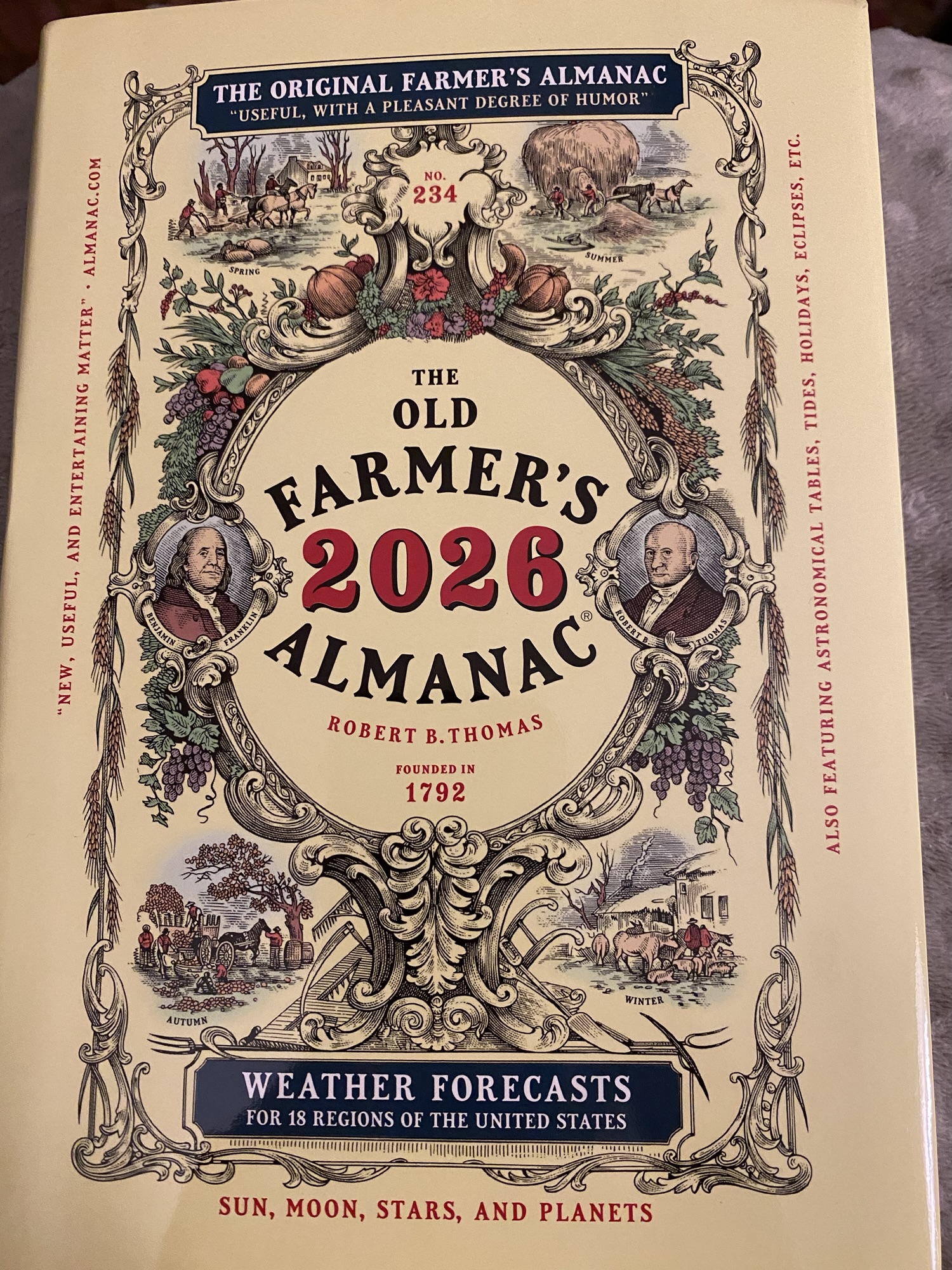
Either I’ve entered the demographic of readers of almanacs or I’ve been missing out on their unique blend of content all my life. The truth is, I never really cared about almanacs since hearing about Benjamin Franklin publishing Poor Richard’s Almanack when I was in elementary school.
I’m fascinated by these amazing compilations of facts and factually-adjacent info nuggets on everything from when to plant bulbs to why the zodiac will be off this year. My sudden interest in almanacs can be blamed on three simultaneous occurrences in the fall: My Dad gave me a copy of the 2026 edition of The Old Farmer’s Almanac, comedian Dusty Slay talked about almanacs on his podcast and Southern Living broke news about The Farmer’s Almanac ceasing its publishing run with this year’s edition.
You’ve got to admit, that’s a lot of almanac activity at one time. It didn’t seem like a coincidence. It felt like a clarion call for a New South Essays journalistic exploration of the topic, or maybe a third grade book report assignment from the mid 1980s. Either way, what I’ve discovered has been delightful.
First and foremost, you need to know that “The Farmer’s Almanac” and “The Old Farmer’s Almanac” are not, in fact, the same. Stick with me here, it’s going to get confusing: The Farmer’s Almanac has been published continuously since 1818 from its headquarters in Lewiston, Maine. “The Old Farmer’s Almanac,” which is NOT going out of business, has been published continuously since 1792 and is based in Dublin, New Hampshire. It’s been around longer than that Johnny-come-lately farmer’s almanac, hence the inclusion of the word “old” in the title.
(Poor Richard published his almanack for 25 years from 1732 to 1757, in case you were wondering.)
Regular readers of almanacs already know this, but it’s really an everyday reference book rather than something you sit down and digest all at once. But that’s exactly what I did to prepare for the Year of Our Lord 2026. The reference section in the back was also extremely helpful when I was preparing a cheese blintz casserole on Christmas morning, and we were short on butter. The Old Farmer quickly led me to mayonnaise which proved to be a great substitute. My family proclaimed my cheese blintz casserole to be “the best ever.”
One advantage to consuming The Old Farmer’s Almanac as I did is that you experience the full impact of its wide ranging advertising. In one span of 20 pages it contained full page, full color ads on growing cannabis, God’s remedy for a world gone mad, Doctor Pooper’s septic tank additives, and Athena’s Pheromones increasing affection you get from others. I am prone to exaggeration, but I am not making this up.
On my first reading, I skipped most of the articles and the section on the zodiac and went straight for the weather, the real meat and potatoes of The Old Farmer’s Almanac. It took a minute to figure out how to comprehend the data. There was a general weather overview for the year on page 97 but the detailed regional breakdowns didn’t begin until page 202.
Georgia is in region 4, according to The Old Farmers Almanac system, and it’s labeled “Southeast.” Region 4 includes Georgia and the Carolinas. The predictions for this year are as follows:
Colder than normal temperatures in the winter with lower than normal precipitation. If there will be snow, look for it in late January. Spring will be warmer and drier than usual in the run up to a hotter than normal summer (Yay!). There’s a tropical storm headed our way in late June and a full blown hurricane in August. Otherwise, our below average rainfall will continue on into the fall when temperatures and precipitation will be below normal.
You may be wondering how the Old Farmer came up with all that. They use a secret formula based on sunspots devised by founder Robert B. Thomas in 1792. Since then, the formula has been revised and updated with state-of-the-art technology, but I like to believe it’s still mostly sunspots.
Seeing as how I don’t plant anything ever, this is all just great fodder for small talk. I don’t know how much small talk I’ll get to indulge in if I lead every conversation with, “Hey, I was reading in The Old Farmers Almanac about how sunrise will be at 6:37 tomorrow morning…”
No topic from The Old Farmer’s Almanac will kill a conversation quicker, though, than the section titled, “Cringers.” As my middle son, Harris, declared while sharing some of its timeless witticism, “This has to be where Paw Paw gets his jokes.”
I hate to spoil it, so I’ll only give you a taste:
- “Just so everyone’s clear, I’m going to put my glasses on.”
- “I’m trying to organize a hide-and-seek tournament, but good players are hard to find.”
- “Writing my name in cursive is my signature move.”
These were credited to a “D.D., of Calgary, Alberta.” Those wacky Canadians, though “D.D.” feels made up.
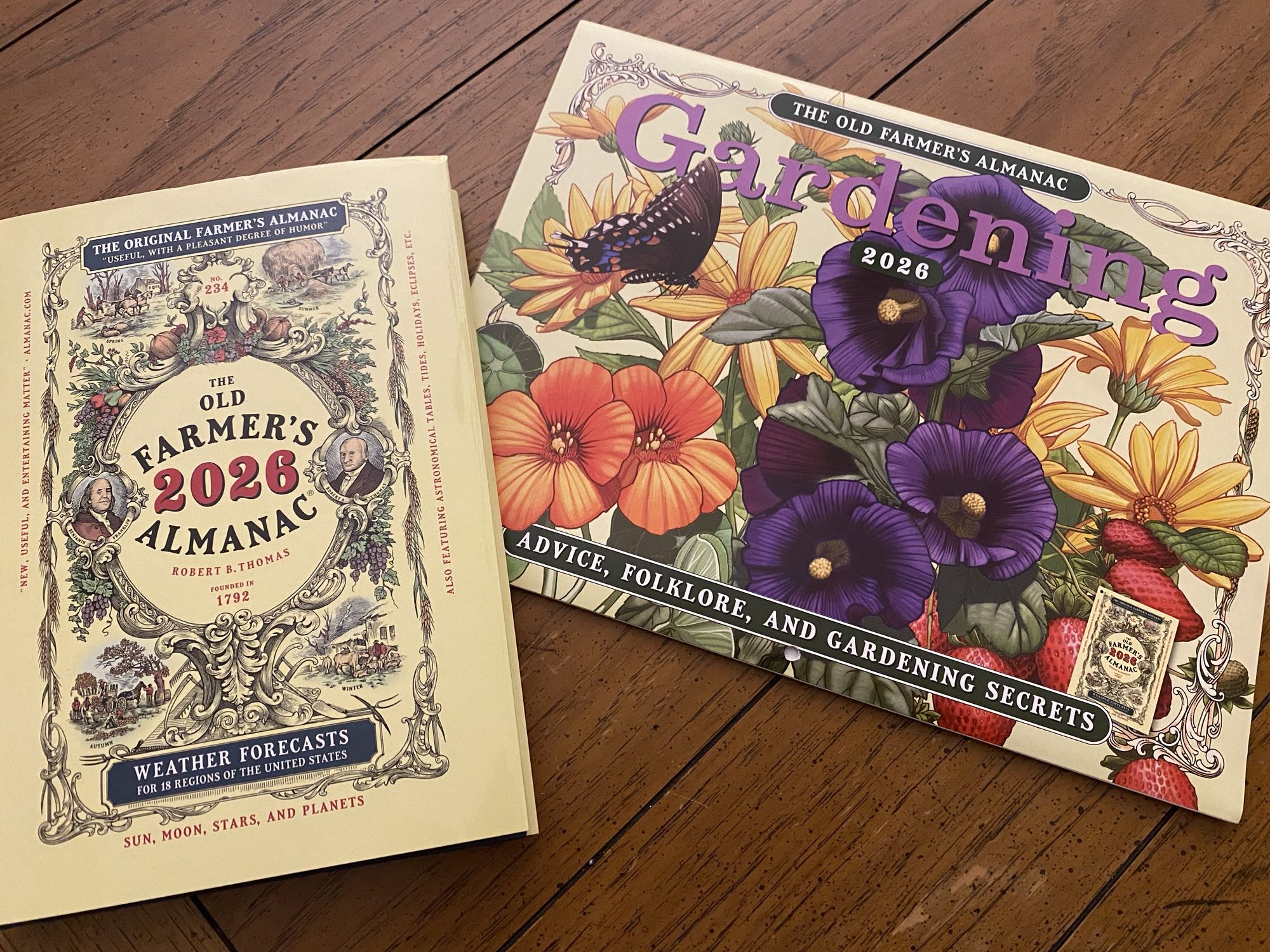
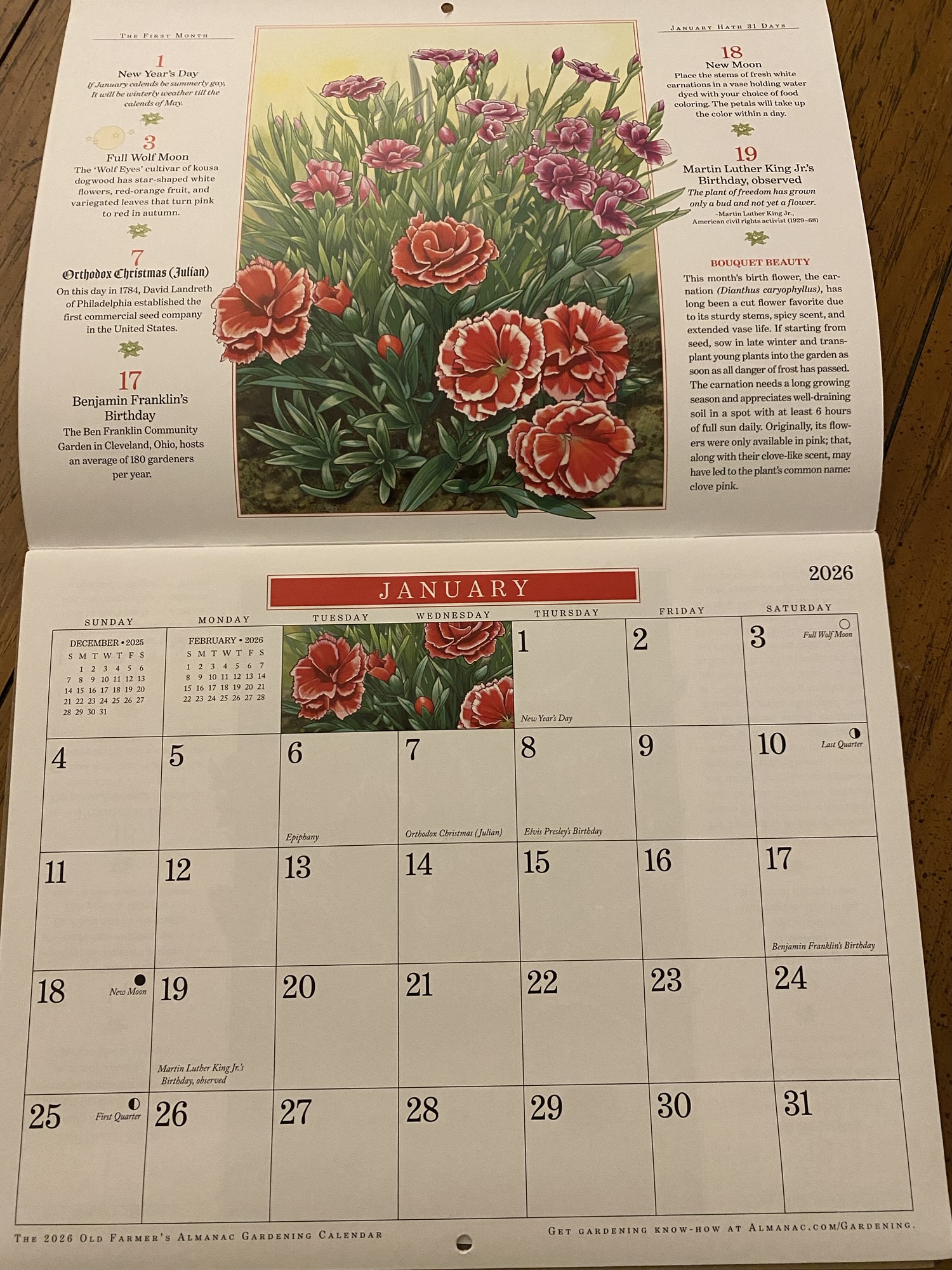
Another great feature of this throw-back publication was the addition of a lovely gardening calendar, chock full of fun facts and floral illustrations. It’ll be a nice addition to my office bulletin board, replacing last year’s calendar of Appalachian Trail photos from my good friend and photographer, Bob Perkins Jr.
I will end this exhaustive, and exhausting, special New South Essay investigative report with these historical concluding words from The Old Farmer’s Almanac’s founder, Robert B. Thomas, with an eye toward adopting some sort of signature weekly sign off for New South Essays:
“It is by our works and not our words that we would be judged. These, we hope, will sustain us in the humble though proud station we have so long held in the name of Your obedient Servant, Robt. B. Thomas.”
 New South Essays