
Scottish actor and musician David McCallum passed away Sept. 25 at the age of 90. Known for his television roles as Dr. Donald “Ducky” Mallard on NCIS and Illya Kuryakin on “The Man from U.N.C.L.E.”, he had numerous acting and musical credits and had a career spanning decades.
My chance encounter with him on June 17, 1994, has made it into the pantheon of stories I relish telling and further contributes to my reputation as the Forrest Gump of journalism.
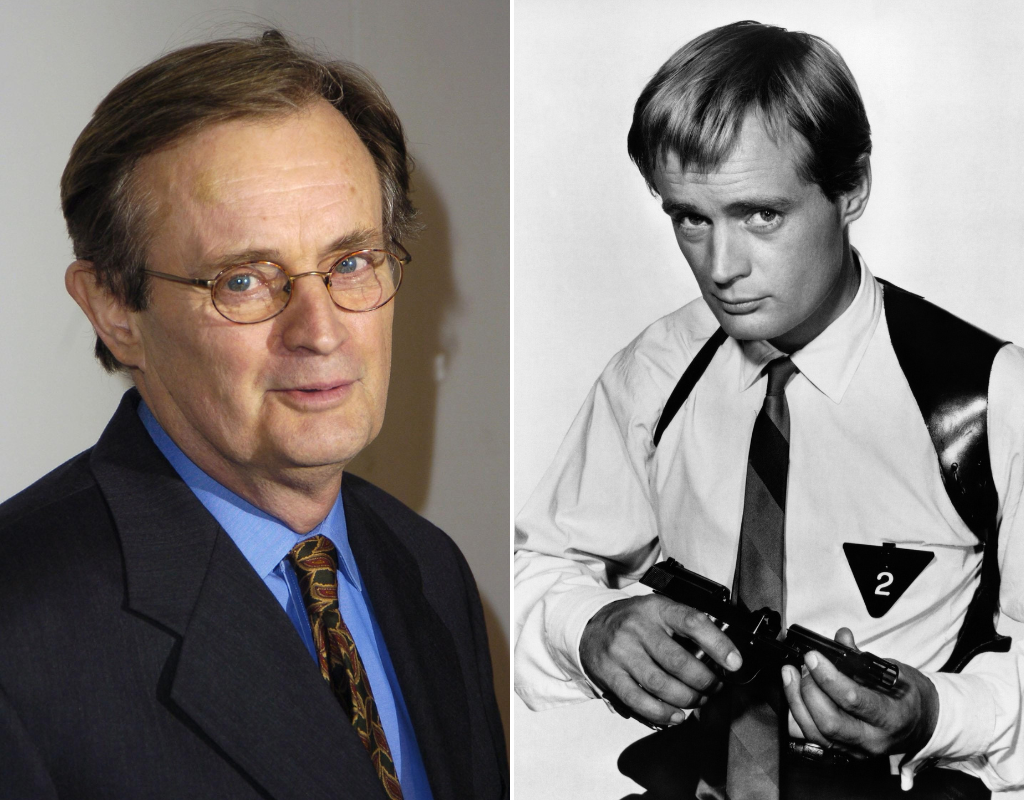
My telling of the story usually goes something like this…
“Hey, have I ever told you about the time I met the man from ‘The Man From U.N.C.L.E.’?”
“You met Robert Vaughn?”
“No, the other man from U.N.C.L.E.”
Or, if my audience happens to be a bit younger:
“Hey, have I ever told you about the time I met the man from NCIS?”
“You met Mark Harmon?”
“No, the other man from NCIS.”
The David McCallum I knew did not deserve second billing. He was a true gentleman who responded with sincerity and grace when confronted by a gawky cub reporter asking weird questions at an inappropriate time.
It all started with the Titanic. Stick with me, this is going to be a bit twisty.
On April 15, 1912, the RMS Titanic sank in the North Atlantic. You may have heard about this.
For a number of reasons, not the least of which was Hollywood gossip about James Cameron’s work on a film, interest in the tragic sinking of the “unsinkable” ship on its maiden voyage surged in the early 1990s.
As a young features writer for The Macon Telegraph, I joined onto a project headed by managing editor Ron Woodgeard about Georgians on the Titanic. I worked with fellow reporter Sheron Smith to research fascinatingd people with connections to the Peach State, and I was one of the credited writers of the main story about the wreck in addition to several sidebars on specific families.
The special feature was published on a Sunday in either late 1993 or early 1994, I can’t remember which, and was entered into several journalism awards competitions.
Lo and behold we won second place in the Associated Press of Georgia’s annual writing awards.To this day it remains the highest accolade I’ve ever received for my writing. As a reward, The Telegraph sent me to the awards dinner at a resort in Amelia Island, Florida, which that year happened to land on June 17.
During the dinner and ceremonies all the way on the opposite side of the country, police were closing in on actor and former football star O.J. Simpson to arrest him for the murder of his wife, Nicole Brown Simpson, and her friend, Ronald Goldman. With the three hour time difference, the dinner ended about the time O.J. was being driven by his friend Al Cowlings in a white Ford Bronco through Los Angeles. The infamous “slow-speed chase” captured the world’s attention and became one of those television moments people from that era can recall easily.
In today’s culture of smartphone connectedness it may seem weird to have to explain, but the way the people I was with that night learned of the incident was from the televisions in the hotel lobby outside of the ballroom. They carried CNN’s live feed of the chase, and the hundreds of banquet-goers were glued to the screens.
I stood in the crowd along with the other Georgia journalists watching the events unfold, honestly a little bemused by all the fuss.
At that moment, Telegraph executive editor Rick Thomas, who sadly passed away in 2017, rushed up and said we needed to get a local reaction story for the next day’s paper. He told me to start doing interviews, and in this pre-internet era, call back to the copy desk with my story.
For the first time in all the hubbub I was stunned. What on earth was he talking about? How could I get local reaction for a Macon newspaper when I was in Amelia Island, Florida? Who was I going to interview besides other Georgia journalists? What connection to O.J. Simpson could I possibly find there that Macon readers would care about?
In hindsight, I think Rick was caught up in the excitement. He was around his peers and wanted to be perceived as being a “true newsman,” always thinking about the news and pursuing a great story. Unfortunately, what he assigned me to do made no sense.
But less than two years out of journalism school, I was in no position to argue with the boss. I scrounged up a hotel pen and one of those notepads they had at pay phones (remember those?) and began trying to find normal, non-journalists to interview about the developing O.J. Simpson situation.
Across the lobby was another set of smaller banquet rooms hosting other, smaller events. I saw a group of people gathered around a TV outside one of them, so I went over and began awkwardly identifying myself as a reporter from The Macon Telegraph (“Where?”) and asking if anyone had thoughts on the slow-speed chase.
My third or fourth victim of “gotcha” journalism had just come out of one of the rooms where a family reunion was occurring. To my amazement, he didn’t think what I was asking was weird at all.
“Oh, you’ll want to speak with my brother-in-law,” the man said nonchalantly. “He knows O.J.”
Surprised and a bit skeptical, I was escorted into the smaller hotel banquet room and introduced to “David.” My contact said I wanted to interview him about the “O.J. situation.”
Honestly, I had no idea who I was talking to. I just started writing when “David,” who was holding a tumbler of some brown liquid, began saying very earnest and sincere things about O.J. as if it was the most natural and expected topic to be discussing in Amelia Island, Florida, with a kid with a hotel notepad and pen saying he was from a newspaper in Macon, Georgia.
I can’t recall his exact quote but it was something along the lines of “I certainly hope this ends peacefully, and O.J. will do the decent thing and turn himself in safely.”
At this point I was sweating with anxiety. I knew enough to know that my source expected me to know who I was talking to. I used my old reporter’s trick of asking how to spell his last name just to get him to tell me his whole name.
“M – lower case c – upper case C – A – L – L – U – M,” he patiently recited with a bit of a quizzical look.
“And how do you know Mr. Simpson?” I asked.
He demurred and mentioned meeting him several times during his years on “The Man from U.N.C.L.E.” I thanked him for his time and let him get back to his family reunion.
I went to the bank of pay phones there in the hotel lobby and called The Telegraph copy desk. Chief copy editor on duty that night, Robin Stacy, answered. When I apologetically launched into my assignment, he was incredulous.
“Rick asked you to do what?”
I took him through my assignment, and he said no one had told the copy desk. He said they didn’t have room for it, and besides, nobody in Macon cared what people in Amelia Island thought about O.J. Simpson. (Exactly.)
“But you might as well give me what you have,” he said.
So I recited my quote and told him the attribution.
“David McCallum,” I said. “I think he was on that old TV show, ‘The Man from U.N.C.L.E.”
Robin hesitated.
“You mean Illya Kuryakin? The Russian?”
“Well, his accent sounded British,” I stammered.
Robin laughed into the receiver. He thanked me for following through on a hairbrained assignment and made no promises that my exclusive interview with Illya Kuryakin from “The Man from U.N.C.L.E.” would make it into the next day’s paper.
In the intervening years since that encounter, I have come to appreciate my chance meeting with David McCallum. I enjoy telling the story, especially after his career resurgence on NCIS. Among my brushes with fame, this one certainly was one of the weirder ones.
But as the world remembers and says goodbye to David McCallum, I am grateful to have at least a small connection to the talented and kind former A-lister from a bygone era. You know, he was always good for a quote.
 New South Essays