
If you have been anywhere near regular old television any time since February 6, you may be aware that people are doing death defying stuff on ice and snow.
These feats will cease to earn medals tomorrow when the Milano-Cortina Winter Olympic Games end, but some unfortunate souls (Yankees, mostly) will have to contend with winter weather for several more weeks, if certain rodents are to be believed.
My experience of the Winter Olympics this time around has been characterized by a preference for the movie “Miracle” rather than real Olympic hockey, only being able to watch curling every time I turn on the TV for some reason, and seeing highlights on all social platforms of people falling, crashing and otherwise suffering bodily harm. The surgery count is higher than the medal count for some countries.
I must confess that I’m having a difficult time relating to these games, mostly because at my age, everything just looks like it will lead to, at worst, a broken hip, or at best, being stove up for a few weeks.
Because I live in the Atlanta suburbs, I also struggle understanding or caring about sports in which winter conditions are a requirement. We get snow every few years, and usually it’s only enough to make everyone stay home. It’s not even enough to make a decent snowman (or snowperson).
I’ve covered my Southern bona fides before, so it goes without saying I have done precious little bobsleighing (sledding?), skeletoning or luging during my years in Texas, Florida, Alabama and Georgia. The 16 sports that make up the schedule of the 2026 Winter Olympics in Milano Cortina (which I think is in two separate parts of Italy – the spaghetti part and the gelato part.) are a bunch of activities I have never done.
For the record, they are, in alphabetical order, Alpine Skiing, Biathlon, Bobsleigh, Cross-Country Skiing, Curling, Figure Skating, Freestyle Skiing, Ice Hockey, Luge, Nordic Combined, Short Track Speed Skating, Skeleton, Ski Jumping, Ski Mountaineering, Snowboard and Speed Skating. These official Winter Olympic events are divided into three main categories: ice sports, alpine/freestyle/snowboard events, and Nordic events.
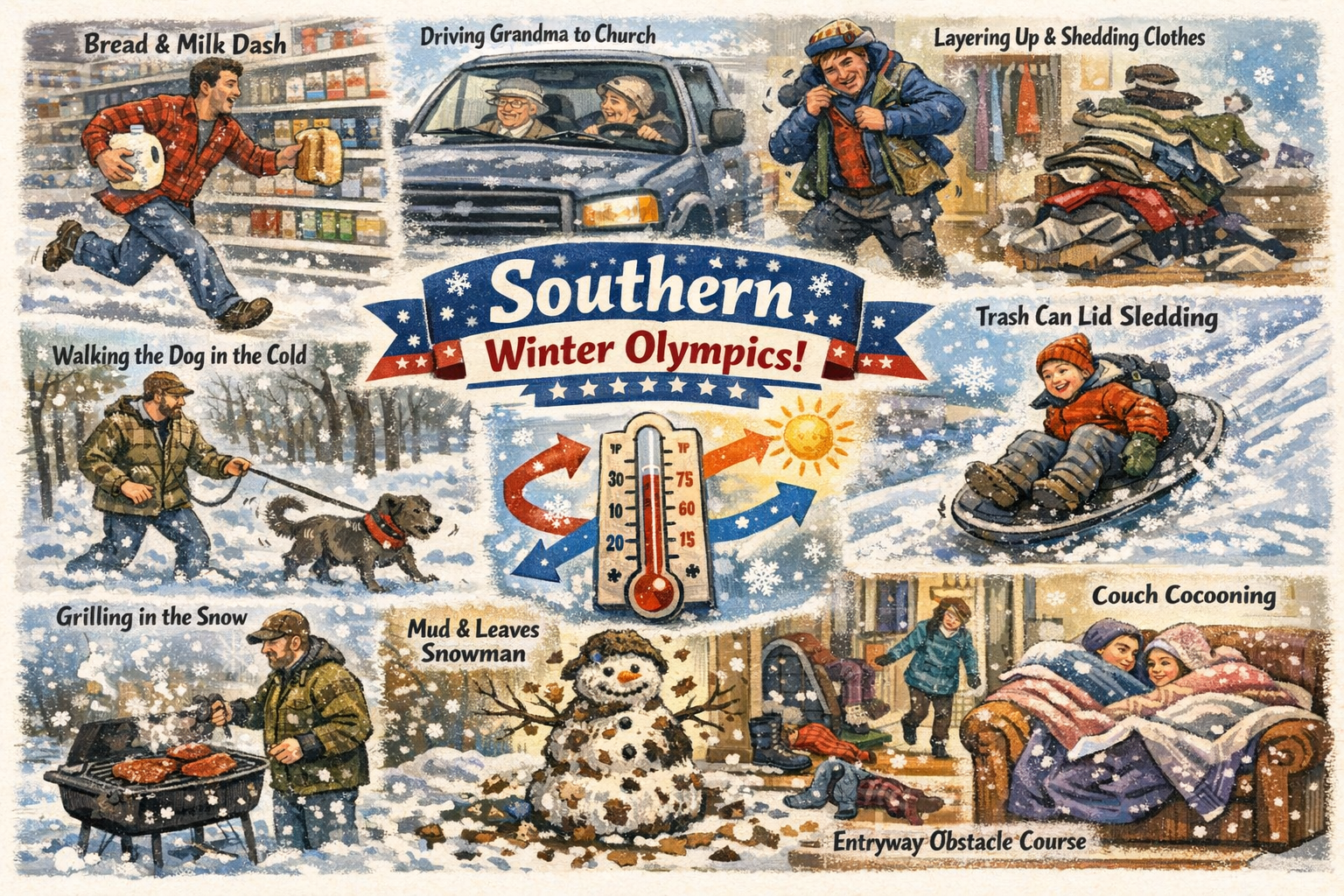
I’m here to propose a version of the Winter Olympics we down South can better relate to and appreciate. As the arbiter of Southern culture, New South Essays has compiled a list of recommended events to be included in a Southern Winter Olympics.
Like the international version, the official New South Essays Southern Winter Olympics would also be divided into three classifications: movement, temperature, and clothing. See if you can guess which events fall into which category:
Bread and milk dash. If you live anywhere in the more Southerly regions of the United States, you know all the cliches about stocking up on bread and milk before a predicted snowstorm. A few weeks ago, I had the misfortune of being in a Kroger on a Thursday night before a forecasted weekend ice storm, and the line to check out was all the way down the baby stuff aisle. Stocking up on the essentials in a Southern grocery store before a snow is WAY worse than buying groceries before Thanksgiving. It requires maneuverability, speed, strategy, perseverance and Olympic levels of friendliness to survive, much less excel. There’s no question medals should be awarded for doing this well. Contestants would be given a list that includes bread and milk, and medals would go to the fastest to complete self check out with the required items.
Driving grandma to church. It’s been established that Southerners cannot drive on snow and ice. Most of the time, we don’t even try. We all still remember what happened here in Atlanta in 2014. Lisa Grovenstein, one of my former bosses from my days at Georgia Tech, used to work at the Georgia Emergency Management Agency. She was an authority on navigating icy roadways. She said the key to driving on snow and ice was to “drive like you’re taking your grandmother to church.” This requires skill not to jostle Grandma about because it might mess up her hairdo, which had to be set overnight after getting it done on Saturday. She also doesn’t like to go too fast because it’s frightening. This Winter Olympic event would be a timed competition. Everyone would use the same 1964 Lincoln Continental with grandmas assigned to contestants at random, like certain equestrian events and horses. Points would be deducted for messed up hairdos.
Adding and shedding layers of clothing. The further South you go, the less true winter clothes folks own. We tend to cope with this by layering up. When it’s real cold, and we’re forced to go out, we’ll put on some longjohns, our regular pants, regular socks, wool socks, an undershirt, outershirt, sweatshirt, fleece, jacket, overcoat, mittens and/or gloves, scarf, hat, and rain/snow boots. If you don’t have the proper footwear, you will put bread sacks over your shoes to keep them dry. I don’t know why, I just know it’s what is done, without question. The problem with this approach is that as soon as you get out and about, the temperature will rise, and you will need to start shedding these layers. Speed and dexterity are featured skills here. For the sake of modesty, competitors start out already in their underpants and T-shirt/camisole so as to prevent incidental nudity. Medals go to three folks who get all that stuff on and back off in the shortest amount of time.
Walking the dog. This is an endurance event, akin to cross country skiing or the marathon from the Summer Games. In case you didn’t know, I can testify that your dog remembers all those times you yelled at him or didn’t give him a bite of your pork chop. Your pooch exacts his revenge when the temperatures are in the teens and maybe there’s a wintry mix. He will walk you all over the place before he does his business, all the while secretly laughing at how long he can keep you out in the cold. This is especially true if you just run out in your pajamas and aren’t layered up properly. Dogs have been known to wait to relieve themselves in such conditions until their owners have lost toes to frostbite or caught pneumonia. Medals go to the three competitors who can get their pet to go the fastest. Must be a no. 1 AND a no. 2.
Temperature fluctuations. Raise your hand if you have ever started your day with temperatures below freezing only to see them rise to Spring Break at Panama City Beach levels by lunchtime. It requires some Olympic-level hardiness to withstand such temperature spikes, and as such, should be included as a sport. This event would occur in climate-controlled spaces. Contestants start out sitting in a walk-in refrigerator with temps set in the teens. After 15 minutes in there, they must switch to a sauna set at 105 degrees. They rotate every 15 minutes until they pass out. Medals are awarded to those who can complete the most rotations.
Trash can lid sledding. I admit that this is sort of a throwback because nowadays we all have these roley bins rather than old fashioned metal trash cans with round lids, but nostalgia can be part of the fun. When it does snow down here, none of us have the proper sledding equipment. We have to go to our Yankee neighbors and borrow theirs. Short of that, we have to make do. College students are famous for stealing the trays from the cafeteria to sled down the biggest hill on campus when snow days interrupt their higher education. This event would be in two formats: lying on your back, like the luge, and lying on your belly, like the skeleton. There does not have to be actual snow for this event to take place. In fact, spotty snow is best at really testing an athletes’ skill. Avoiding muddy patches to stick to the spots with the most accumulation of slick snow is part of it. Winners obviously are the ones with the fastest times down the hill.
Outdoor Ice Grilling. Unless you have a natural gas stove in your home, when winter weather inevitably knocks out your power down here, you have to resort to other forms of heating your food. Sure, you could use all that bread you bought to make cold cut sandwiches, but where’s the fun in that? To demonstrate your resourcefulness, you need to grill meat (or veggies) outside on a grill. It can be charcoal or gas. This competition would require judging, like a combination of figure skating and Chopped, the American cooking reality TV show that has been on for 64 seasons. There would be three rounds with different foods cooked to a prescribed level of doneness. Oh, and this must be done in full winter weather clothes, including gloves (no fingerless gloves allowed), whether or not there is snow on the ground. We all know that you don’t need actual wintry precipitation to lose power and have to cook outside.
Snowperson building. Like the grilling above, this event would be judged. The only requirement is that the sculpted figure must be in a roughly humanoid form. Like all good Southern snowpersons, snow is not required. If there is an insufficient quantity of snow, competitors must supplement with leaves and mud. Judges would reward competitors for stability, realism and ratio of snow to mud. Fake snow is not allowed. Part of the challenge of this event would be conditions, just like on snow skiing events in the real Winter Games. If it happens to be snowing, then, great. If it snowed last night and it’s already turning to slush, welp, you better get busy. And if you think you want to build a pure snow snowperson but you don’t have much snow to work with so you go with one of those quarter scale models, that’s risky. You will be counted off. Yes, you may have a purer snowperson, but judges give more points for height. Everybody knows when it comes to snowpersons, bigger is better. If your snowperson could start in the NBA, you’re practically guaranteed a medal.
Entryway obstacle course. Every time it snows down here, folks go to posting photos on the Facebook of their kiddos frolicking about. The penultimate shot in the photo gallery, just before the picture of the cherubic children enjoying mugs of hot cocoa, is usually an image of the front hallway of the home with piles of wet clothes tossed about. When you layer up those kids for winter play, it usually only takes a few minutes for them to get wet and miserable. That means the amount of time they spend in the elements is typically only a fraction of the time it took to get them layered up and an even smaller fraction of the time those layers lie in the floor of the entryway. This is a timed completion. Competitors must complete an obstacle course of wet clothes through a narrow home front hallway. You must be careful because lurking under a pair of soggy tights might be a stray rainboot. Step on one of those wrong and you’ll twist an ankle for sure.
Couch cocooning. Every Winter Olympics has that one sport you watch and think, “I could do that.” (See earlier reference to ubiquitous curling.) Well, this is that event. During the winter, we cold weather averse Southerners take our couch potatoing to new levels. Come spring time, we not only have to pull weeds, mow the grass, and clean the gutters, we have to smooth out the indentations in our sofa cushions created by our hindquarters over three months of settin’ still in front of the TV. This is a timed and judged event. Medals are awarded to those with the greatest stamina and the most blankets. Held indoors, obviously, the object is to stay on the couch the longest without having to get up. Bladders and bowels of steel required. It also helps if you are cold natured so you can get “Princess and the Pea” quantities of blankets stacked on top of you without excessively perspiring. This one may not get ratings, but it would be easy to squeeze in bonus coverage around the trashcan lid sledding and entry obstacle course.
That’s it. There’s your Southern Winter Olympics. It could be hosted in cities around the South from Northern Virginia (more snow) to Miami (less snow). Or it could just be hosted in Atlanta every year like the SEC Championship. Either way, I think this concept has real possibilities.
Enjoy the final day of the Milano-Cortina Winter Games. I think there’s at least seven more rounds of curling.
I’m curious to see if you have other events you’d recommend. Leave a comment below with your suggested Southern Winter Olympic sport, and be sure to describe how one would medal.
 New South Essays